
By Design AI Data Sovereignty: Regional Deployments, Residency Guardrails, and Postgres
Business focuses on compliance more than whether the AI system will work well or not. The data sovereignty stands with models (online and offline ones), vector storage (postgresql), memory layers, and data sets left for retrieval. It is not just a check box in the region, state, or some other realm across which these models […]
RAGs to AI Agents: Changing Data Architectures Without Compromising Governance
Today’s enterprises are bringing the stage from simple lookup systems to autonomous agents equipped with AI, which will perform tasks, make independent decisions, and adapt themselves every minute without manual input. It may well be that Retrieval-Augmented Generation is the best first step; it would have worked perfectly, but today’s work demands more than that-in […]
Memory Layers on Top of Enterprise Data: Providing Context to Agents and RAG Systems
The Contextual Importance in AI Systems Context is one critical component in many others that color the ability of a modern artificial intelligence system-like large language models, retrieval-augmented frameworks, or intelligent agents-to either generate, process, or analyze in vain. An AI forgetting previously processed inputs is essentially a parallel-often in an informal way-to a competent […]
Similarity Search Operationalization: Index Method Drift Detection and Quality SLAs
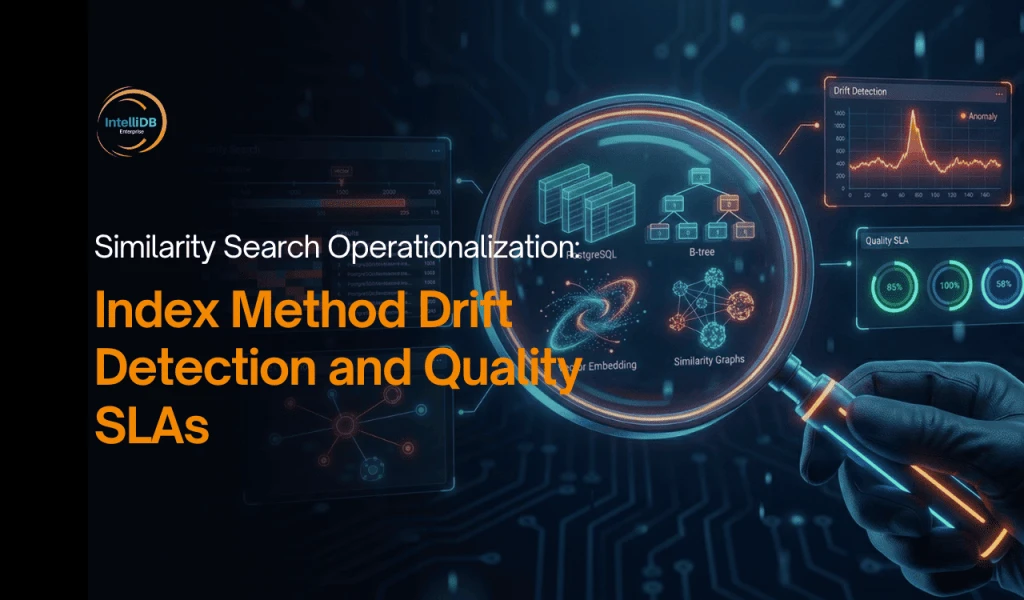
AI today is really powered by core similarity search allowing pretty much everything from personal XRECs to smart document searches in a totally digitized world. Is it modern enough to discuss the scaling of such technology in an enterprise? Let’s first consider the question troubling every one: How can searches remain semantic fast and accurate […]
Use Cases for Production with pgvector: Moving from Postgres to Postgres+AI for Vector Workloads

What is hot in AI buzz? That’s right, AI ushers in a new way of storing, processing and retrieving data. Oldschool relational databases such as those best known for PostgreSQL were simply optimized for structured transaction data. In such a way AI workloads work on vectors. Vectors capture meaning relationships and context which is what […]
Self-Healing Databases : Journey from Reactive Tuning to Autonomous Postgres
For the most part history passed database administration to systems query tuning executed manually and performance fixes done reactively to preserve these systems for long hours under oceanic database administrator labor. In such a datacentric world where almost everything is demanding millisecond application response time and no downtime, manual tuning hardly can keep pace anymore. […]
AWS Marketplace: AI Data Sovereignty Governance Framework
As artificial intelligence (AI) continues to drive the digital transformation of every industry imaginable, issues regarding data sovereignty—the principle that data is bound by the laws and governance of the country in which it is collected—have risen further up the agenda of stakeholders. Cloud providers are rapidly evolving their offerings, like AWS Marketplace, to allow […]
How are cloud and hybrid data centers evolving in 2025?

The digital ecosystem is changing dramatically in 2025. Artificial intelligence (AI) is now part of the way organizations conduct enterprise business operations, so data sovereignty (keeping data in jurisdictional authority and control) is now front and centre. Governments, organizations, and cloud service providers are reshaping architecture so they can adhere to data privileges while still […]
Managing Big Data with PostgreSQL and Generative AI: Can GPTs Really Help
In a world that can be accurately described as data-driven, managing large volumes of data requires more than old database technology, it requires intelligence! Many organizations are now thinking about how they can combine the rapidly advancing generative AI models like ChatGPT and GPT-4 with existing and proven database technologies like PostgreSQL. Organizations, and their […]
AI & LLM Data Privacy & Data Sovereignty

Artificial Intelligence (AI) and Large Language Models (LLMs) are drastically reconfiguring the digital enterprise environment at unprecedented rates.From real-time data-updates and analytics, to novel content generation capabilities, and automation, AI is being assimilated deep into the native operations of day-to-day business.However, with this rapid transformation, enterprises are increasingly concerned with data privacy, cross-border flow of […]