
IntelliDB at GITEX AI Europe 2026: AI-Powered PostgreSQL Database Management Platform Takes the Stage in Berlin
Enterprise databases are under more pressure than ever to perform faster, scale further, and stay secure, all while demanding less manual upkeep from already-stretched IT teams. That is the exact problem IntelliDB’s AI-powered PostgreSQL database platform was built to solve, and it was the conversation we brought to Messe Berlin this year, as part of […]
PostgreSQL High Availability: How IntelliDB Enterprise Keeps Your Data Always On
If your business runs on PostgreSQL, you already know the database is more than infrastructure; it’s the backbone of every transaction, customer interaction, and decision your applications make. So what happens when that backbone goes down, even for a few minutes? For most enterprises, the honest answer is: a lot. Lost revenue, broken SLAs, frustrated […]
Why Market Is Betting on Governed AI Data Platforms- And Its Implications for Postgres
Until just recently, AI performances dominated this world: larger models, faster inferences, richer embeddings, just some catch-all buzz words. These AI systems matured, and high-stakes environments with applied -AI began instituting into sectors such as Finance, Healthcare, Energy, IT, and Public Governance-then leaders entered, expressing passionate opinions; yet it was never about capabilities that a […]
De-risking Vector Stores: Controlling Access, Freshness, and Compliance While Centralizing Risks
Vector databases have now transitioned from proof-of-concept to instead add value for a whole set of industry use cases: personalization of search, fraud detection, agent workflows, and enterprise RAG systems. Then we come to the more difficult question of how vector stores can keep to compliance, freshness, access-control, and security under a constantly murky situational […]
Real-Time AI over Streams: Making Convergence of Kafka and Flink Context into Postgres-Backed Systems
Real-time intelligence has become a necessity for any business. AI is not only relegated to back room handling anymore but instead works at the same pace as events-material-action-customer interaction, transactions, fraud signals, IOT telemetry, operational triggers, etc.-turning them into enormous fast-moving streams that should be analyzed in real time. That is why Kafka and Flink […]
Database Agents: Executive Guide to Self-Healing in 2025
By IntelliDB Enterprise In fact, enterprises nowadays function in unbelievably low millisecond customer experiences, while downtime readily translates to actual financial loss. Well, while traditional and powerful, PostgreSQL still relies heavily on manual tuning, on reactive monitoring, and constant human oversight. But in 2025, this cannot continue. With the amount of AI workloads and exploding […]
SLA-Grade High Availability for AI Applications: Replication, Failover, and Uptime Engineering
AI cannot be programmed to work “within acceptable downtime windows” since it is, in fact, working 24/7 online. The user experience, quality of prediction, sustained automation, and revenue-generating viability demand the most critical of milliseconds. High availability (HA) is no longer regarded as a luxury in these situations; it has become a predetermined SLA requirement. […]
AI secured by design: Encryption, Redaction & Audit controls for vector databases
Vector databases have become fundamental backbones for RAG systems, semantic search, and AI agents. They store: embeddings, reasoning traces, context windows, and real-time memories—data much more sensitive than most organizations understand and realize. However, compared to OLTP and other analytical systems, such vector stores frequently comprise the least governed, least encrypted, and least trustworthy part […]
Postgres AI Observability: The Automatic Transformation of Logs into Insights, and Insights into Action
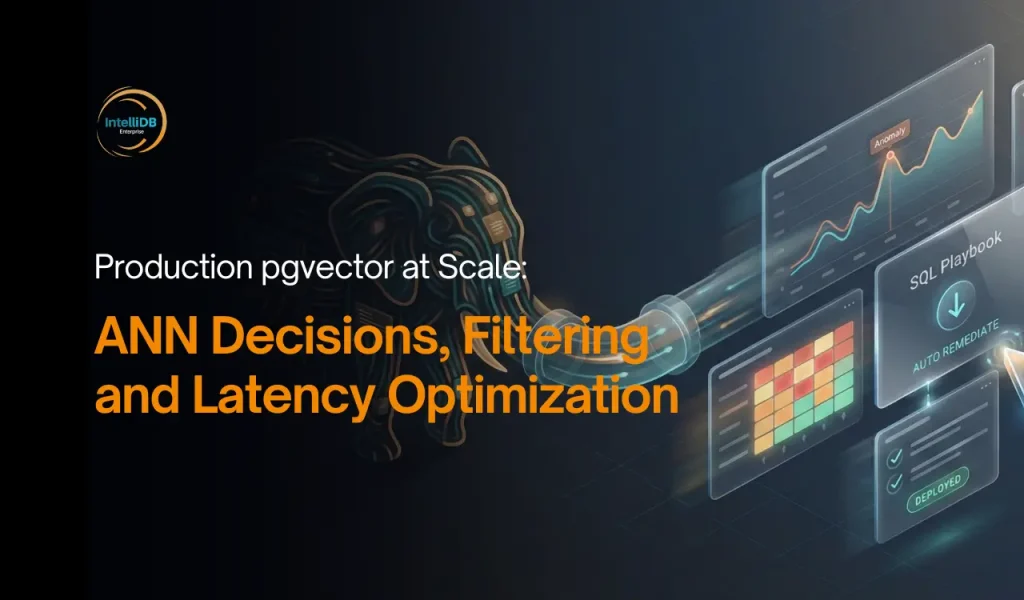
PostgreSQL can be described as the workhorse of all transactional systems, analytics, and mission-critical enterprise workloads. But with the rise of AI-driven applications, agent workflows, and vector-accelerated pipelines, the operational implications have risen dramatically. Now, systems are generating ever-increasing amounts of logs, presenting diversity in the nature of queries never seen before, and unpredictable workloads. […]
Production pgvector at Scale: ANN Decisions, Filtering, and Latency Optimization
The gradual transition from experimental semantic search prototypes to full-blown AI systems by enterprises has transformed pgvector on PostgreSQL into the de facto choice for embedding storage defined for search and memory for AI agents. The most striking differentiator is ironically quite simple: the vector search runs inside the same governed, transactional database where all […]