
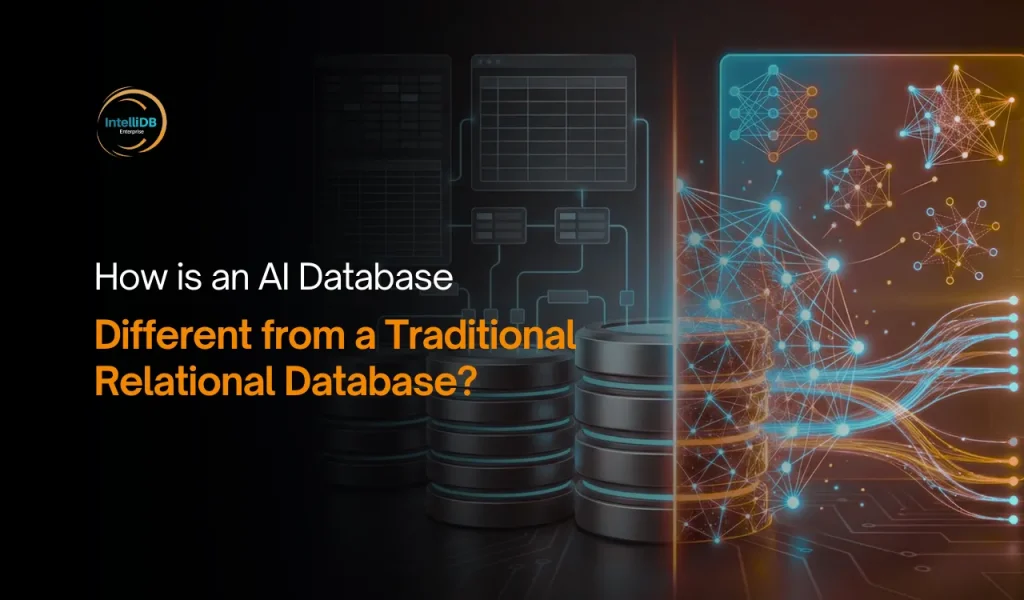
Databases have been the backbone for digital systems from the beginning, and traditional relational databases (RDBMS) such as MySQL, PostgreSQL, and Oracle have powered transactional systems for decades, providing consistency, reliability and a nicely organized structure to the data. Now, with artificial intelligence, machine learning, and unstructured data on the rise, there is an entirely new style of database, the AI database, or often referred to as a vector database. While both databases function through the storage and retrieval of information, they are architected and designed for entirely different workloads.
Traditional Relational Databases
Relational databases revolve around structured data. The information is stored in rows and columns, with a schema that provides a rigid structure, not something to be changed lightly. RDBMS excel in handling transactions—processing payments, inventory management, or customer records, due in part to their commonly strict observations of ACID properties (Atomicity, Consistency, Isolation, Durability).
They are at their best when:
Processing structured, tabular data
Facilitating exact matches and complex queries with SQL
Ensuring consistency of data in highly transactional environments
If you want to know “How many sales happened yesterday,” or “What customers bought product X?” then relational databases can get you that data quickly and reliably. Where relational databases begin to get limited is where the data becomes more complex, unstructured and high-dimensional.
The Rise of AI Databases
AI databases (also known as vector databases) store and search embeddings, which are numerical forms of unstructured data (text, pictures, audio, or video) produced by a machine learning model. Embeddings are high-dimensional vectors used for calculating similarity between data items. Instead of searching for an exact match, AI databases have been optimized to answer questions like “Which image is most similar” or “Which document is semantically closest to this query?”
Key strengths of AI databases include:
- Rapid similarity search across hundreds of millions or billions of data points.
- Efficient handling of high-dimensional vector data.
- Approximate nearest neighbor (ANN) queries, for speed, and scalability.
Integration with AI/ML pipelines to build real-time recommendations and semantic search.
These characteristics make AI databases perfect for recommendation systems, semantic search engines, fraud detection, and personalized user journeys.
Core Differences Between the Two
The main difference between an AI database and an RDBMS is the type of data each is built to process. An RDBMS has been optimized to work with structured, transactional workloads. An AI database has been designed to work with unstructured, or semi-structured data that has accurate numeric representations as vectors.
A second major difference between an AI database and an RDBMS is how the databases deal with query patterns. An RDBMS would deal with exact queries in the form of filters, joins, and aggregates on structured data. An AI database will deal with queries of similarity, often using a set distance measure (e.g. cosine similarity, Euclidean distance) to
Practical Examples
To better understand the distinctions, consider these examples:
E-commerce: A relational database manages inventory, order, and payments. A vector database helps to recommend “also like” if a customer has been on a product page, and finds products that are similar to the one just reviewed.
Search engines: Traditional databases can only return single matches from keyword searches, AI databases can provide semantic search, returning results based on meaning and not word-for-word.
Image recognition: An RDBMS can only have metadata for an image, a vector database could help with finding visually similar images based on embedding and comparisons.
Choosing the Right Database
Choosing a relational database versus an AI database really isn’t about one versus the other. It’s about the right tool for the right job. In fact lots of modern systems are using both together:
Relational databases work with structured, transactional data.
AI databases work with unstructured, high-dimensional data, and similarity search.
For example, a recommendation system might fetch similar items from the vector database, and then provide the recommendation details from the relational database which might include the price and availability.
Conclusion
Relational databases will always serve a highly valuable purpose with structured, transactional workloads and AI databases are made to fulfill the demand of growing AI and ML applications. They vary from each other in the type of data supported, focus of the queries, column index systems, and acceptable performance trade-offs — but together they create a powerful hybrid mechanism that supports traditional business practices and current AI-enabled experiences.
As our world continues to produce more and more unstructured data, AI databases will be central in developing the next wave of intelligent applications.