
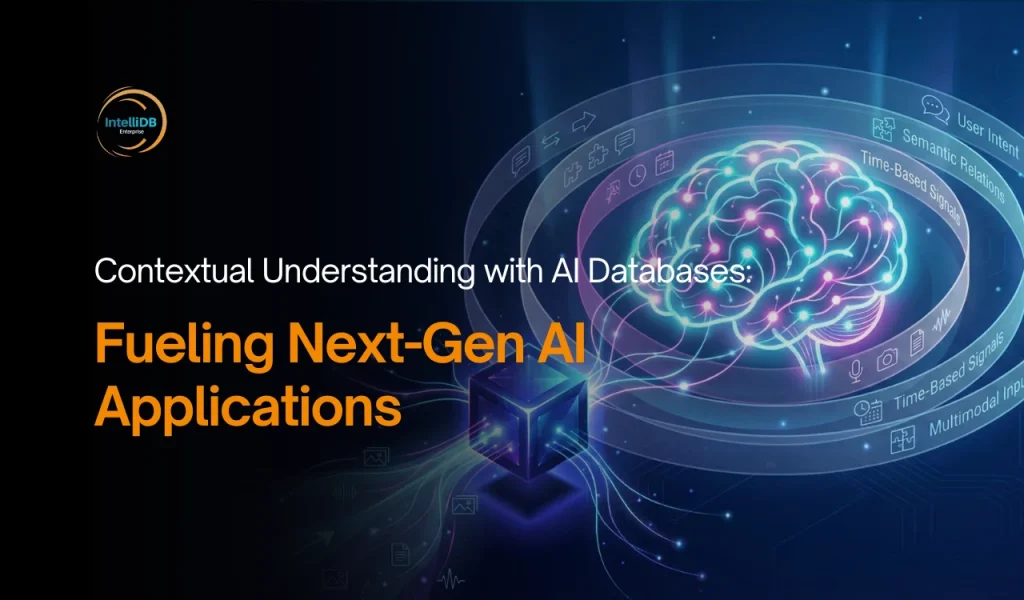
The AI realm continues to present a dynamic interface, with the resurgence of another old problem of AI: absence or lack of context. If a model does not have context, it cannot render output in a way that meets the need or is appropriate. The RAG system generally makes a good example of how AI-based databases can provide nearly pinpoint accuracy or realtime correct answers to inquiries.
Now Why Is AI Lacking Context?
While it is true that increasingly big language models are mostly in charge but remaining almost the same throughout their service life makes many of them susceptible to over-confidence’s so-called: The more accurate verdict stands: the AI model is significantly devoid of timely proprietary information in any high-stakes sector like finance or healthcare, where quick decision-making and access to up-to-date information forms the ad-hoc operational center. Thus, the added value from the AI database is to act as an extant knowledge base that boosts the model with real-time information in each case.
Take an example in the case of a customer-support-chatter chatbot made for answering sources of common-lore questions rather than answering grounded in contextual information. But with an AI database, the trustworthy, same chatbot could also hop onto and reference product manuals, prior conversations, and cutting-edge company policies to address one kernel of very accurate and personalized support.
Real-World Application of Contextual AI
Business Research: Indeed, Pinecone was installed for Entrapeer to automatically process a thousand startup profiles. For its clients, it led to instant contextual research at nearly zero operational cost. The business excellence is shifting from static summaries to answers geared toward their specific requirements.
AI Agents: MindsDB and Weaviate solutions lead to the formation of the enterprises’ own AI agents directly to work from their data, while they also ensure better privacy of the sensitive data for better relevance of the output.
Healthcare: Companies like Kry and Mars Science & Diagnostics have a plethora of support from Azure AI for any acute and contextual AI systems. Subsequent experiences for healthcare providers would also include in-time, institution-based insights with a quest against their accuracy and efficiency.
Benefits from Contextual AI Databases
- Better Accuracy: An AI architect ought to have context as well as knowledge.
- Trying to shield Outcomes: Specter of misinterpretations is lowered, meaning less casualty.
- Personalized: Making a stage from available histories for smart and profound computations.
- Future Markets: The goal is to give birth to system handles placed in the role of AI agents, smart assistants, actioning systems, and whatnot on some specifics in design.
Strategic Importance of Context
Context acts as a strategic element, and so has great significance. Businesses that have embraced AI solutions injecting context into data are truly in a better position to serve their customers, build new forms of trust, and foster innovation. Devoid of the context, AI is a background box which customers are always weary of. In contrast, when grounded with the context, AI morphs into a tool for decision-making.
Conclusion
True AI forward lies not at the scale of models or the increase in their parameter; rather, it is about super-smart systems that would know when and where to operate within the context. AI databases must henceforth act as enablers and address the breaches between raging computational power and practical wisdom that makes sense in this world. Any organization seriously considering going forward in this direction without the AI database would be foolish.