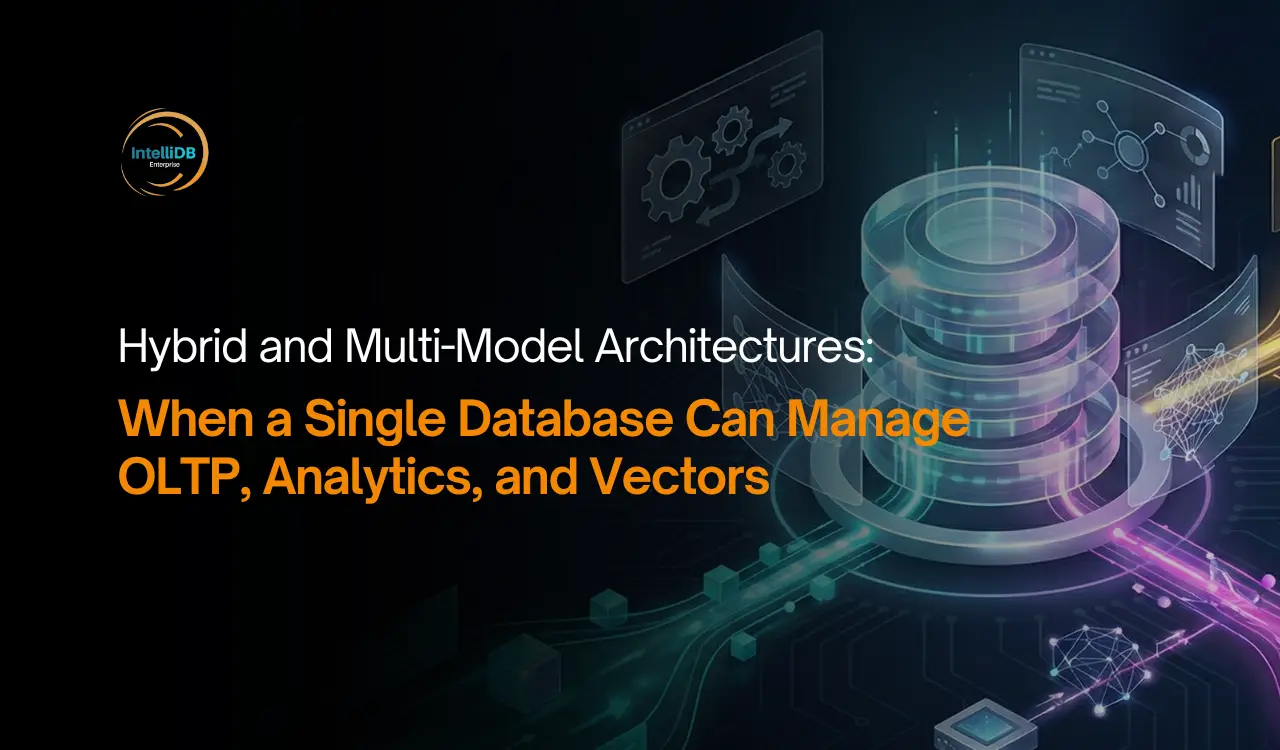
Modern enterprises do not exist in neatly separated data environments. Transactional workloads (OLTP), analytical processing (OLAP), and vector-based AI retrieval have converged. Customer transactions feed real-time dashboards; dashboards feed machine learning; embeddings update decision engines; and AI agents manipulate both structured and unstructured data.
The old idea-that of using separate systems for each workload-creates complexity, latency, and cost. Rampant with this issue, Hybrid and Multi-Model Database Architectures are poised to be the next major shift in enterprise data design.
Contemporary multi-model systems are now capable of handling OLTP, analytics, vector search, time series, JSON, and AI-driven reasoning under one engine-eliminating fragmentation and realize their full intelligence at scale in real-time.
Reasons Why Multiple Data Engines Are Becoming Unsustainable
Enterprises traditionally use several point solutions:
- PostgreSQL/MySQL for OLTP
- Snowflake/BigQuery/Redshift for analytics
- Elasticsearch for search
- Redis or DynamoDB for caching
- Dedicated vector databases for AI and embeddings
The architecture worked in pre-AI times-when workloads were predictable, and applications did not require deep semantic reasoning. Modern systems, on the other hand, require the following:
- Instant retrieval of structured + unstructured + vector data
- AI agent workflows that read/write across multiple formats
- Real-time analysis of customer behavior
- Updates to embeddings without operational friction
- Governance across all data types
Fragmented environments create problems such as:
- High latency due to cross-system data movement
- Exploding cloud cost from duplication, egress, and replication
- Governance gaps between relational, event, and vector data
- Slower AI models because data is never in one place
- Complex pipelines that require constant maintenance
With AI agents becoming increasingly autonomous, these challenges are approaching blockade rather than mere inconveniences.
Which is why the transition towards multi-model platforms is gaining even further traction, as they consolidate the entire data lifecycle into one governed, optimized engine.
What Is Considered Hybrid Multi-Model Architecture?
A hybrid DB is not simply a relational DB extended with “extra features.”
It is a consolidated machine for the native storage, indexing, query, and optimization of different data types, including:
- Relational / structured
- Semi-structured (JSON, documents)
- Analytical columnar data
- Vector embeddings
- Time-series signals
- Logs and event data
The core capabilities that make this possible are:
1. Unified Storage Engine
A single physical storage layer supports both row-oriented OLTP and columnar OLAP.
This enables:
- Real-time analytics on live transactional data
- Reduced redundancy (no ETL into external warehouses)
- Lower storage cost
2. Unified Query Execution:
The database intelligently routes queries to the optimal path:
- Row engine for OLTP
- Columnar engine for analytics
- ANN (Approximate Nearest Neighbor) index for vectors
This gives near-instant responses across workloads without needing multiple systems.
3. Unified Indexing
Indexes for B-Trees, GIN indexes, columnar metadata, and vector indexes coexist in a coordinated structure. An optimizer picks the best route automatically.
4. Unified Governance
One permission model, one audit trail, one encryption layer.
This removes the compliance risks created by multiple specialized systems.
Need for AI and Agents-Multi-Model Rationale
AI workloads are hybrid by nature.
A single inference pipeline often needs to:
- Pull user profile (OLTP)
- Search historical interactions (analytics)
- Retrieve embeddings (vector search)
- Update memory with new vectors
- Log reasoning steps
If these systems live in different databases:
- latency spikes
- data becomes inconsistent
- agents behave unpredictably
- embedding drift goes unnoticed
- memory updates can break governance
A unified engine solves all of this. AI agents can perform transactional actions, semantic reasoning, and analytical queries in the same memory space, with a governed audit trail.
This is exactly the direction enterprises are moving: from RAG to full-fledged AI agents that work reliably only on unified multi-model foundations.
Vector + OLTP + Analytics: The Real Breakthrough
The biggest advantage of a multi-model database is the ability to run:
- OLTP transactions
- Analytical aggregations
- Vector similarity search
- Agent memory operations
all together, without data movement or complex pipelines.
This unlocks capabilities such as:
Real-Time Personalization
Query structured data + embeddings + recent interactions to produce recommendations instantly.
Operational Intelligence
Databases analyze their own logs, detect performance drift, and self-optimize.
Agent Workflow Orchestration
Agents can read/write rules, context, and memory directly inside the database—governed, logged, and safe.
Conclusion
Hybrid and multi-model architectures are not a feature upgrade—they are the next evolution of enterprise data systems. Organizations now need databases that can simultaneously power OLTP apps, real-time analytics, vector search, and AI memory layers without fragmentation and without adding operational burden.
By unifying all these workloads into a single governed platform, enterprises unlock:
- lower cloud TCO
- real-time insights
- faster AI performance
- reduced architecture complexity
- safer and more explainable agents
A single database managing OLTP, analytics, and vectors isn’t just possible-it’s becoming the new standard for AI-ready architectures.