AI today is really powered by core similarity search allowing pretty much everything from personal XRECs to smart document searches in a totally digitized world. Is it modern enough to discuss the scaling of such technology in an enterprise? Let’s first consider the question troubling every one: How can searches remain semantic fast and accurate with changing data and models?. It is operationalized; IntelliDB Enterprise is poised to redefine it in PostgreSQL.
Scalability Problems of Meaning-Based Searching
Traditional SQL queries by and large perform operations of exact matches. Really AI-driven experiences are the opposite of this: they look for semantic similarity which means finding things “closest by meaning” rather than “closest by similarity” which is what the older ones did.
At this point the entire search turns into something much more complicated than just maintaining quality over drift. It is maintained under conditions in which such organizations manage millions or billions of vectors.
AI adoption is forging ahead at an unprecedented rate, rendering somewhat useless the daringly preposterous premises of data and embedding drifts. Tiny changes in this model misalign within millions of stored vectors during mammoth deployments. The enterprises want quality SLAs defined in terms of recall and latencies beyond performance, which the IntelliDB AI Database Agent guarantees through real-time optimization.
Index on Scale: The Right Technique for Selection
Intelligent indexing defines a successful pipeline for similarity search. IntelliDB Enterprise lends itself to advanced ANN algorithms that are Approximate Nearest Neighbors.
- HNSW (Hierarchical Navigable Small World) – High Recall Low Latency.
- IVF (Inverted File Index) – for humongous scale clustering.
- PQ (Product Quantization) – for memory-efficient compressed searching.
All of these types are SLA-compliant latency and recall rate preserved in queries by the IntelliDB AI agent automatic adjusting and maintenance of those indexes requires no human interference.
Adaptive Index Lifecycle: The IntelliDB AI Database Agent does not just build indexes, but it manages them; thus, monitoring frequency of queries, access pattern detection, and dynamic changes in indexing strategies from workloads during peak loads of traffic; IVF to PQ, for example, may enable more queries concurrently while operating under a smaller memory footprint.
Drifting Detection: Keeping Really High Quality Search
The new data rolls in- the behavior of users changes, or the AI model evolves, each of those can cause drift in an embedding.
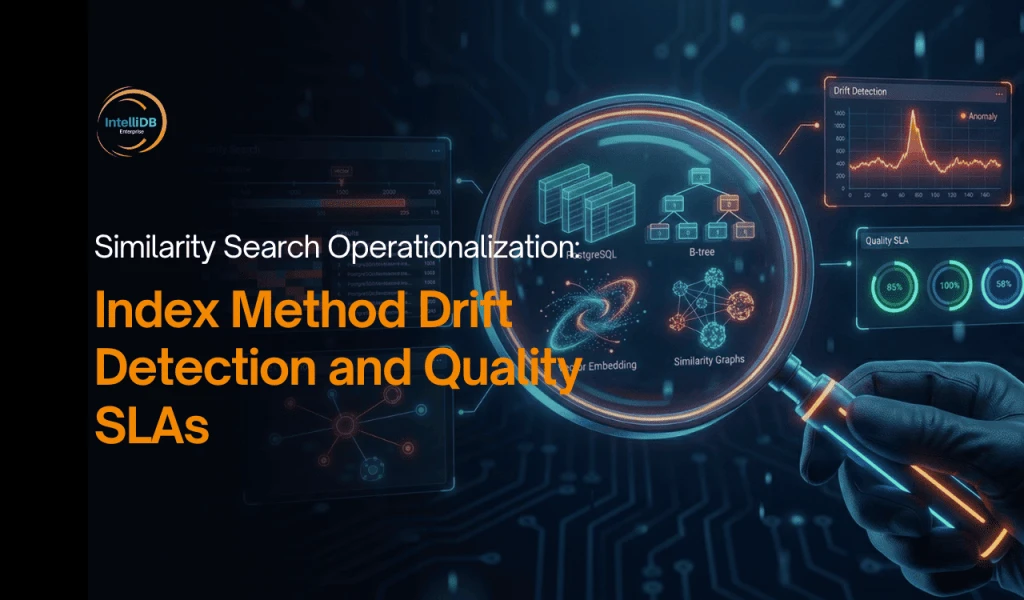
If not detected drift will result in lower quality results and introduce more false positives into the process. IntelliDB Enterprise continuously looks for changes in vector distributions that can jeopardize the health of an index. If a threshold is broken it issues the automatic processes of either re-indexing or updates of the partition.
This means that you keep the quality SLA-s like “95% recall within 40 ms” without any human supervision.
The Operationalization of Similarity Search
IntelliDB reinforces the enterprise layer such that resemblance searching is production-ready;
One Interface for All Monitoring– The health of your index latency metrics and drift statistics are all viewable on a unified monitoring dashboard.
Governance– Governed Integration-All vector workloads have encryption auditing and access policy implemented.
Hybrid Workloads– This means to perform vector search together with relational joins like to find similar products and then directly pull inventory price or availability from the relational tables.
Predictive Maintenance– IntelliDB predicts load changes and automatically adjusts cache/thread allocations.
Business Impact
Companies that have used IntelliDB’s similarity engine declare that:
Search and recommendation outputs are 30-40% more relevant.
Vector queries were executed 50% faster than with standalone systems.
Automated drift detection results in full-time assurance of SLA compliance.
Such benefits translate into concrete benefits for the enterprise-fast user journeys, increased engagement, higher conversions and minimum operational escalations.
Industry-Specific Insight
Retail: Conversion rates grow, bounce rates lowered because of enhanced personalization.
Finance: Increased accuracy of fraud detection models through behavioral twin profiling.
Healthcare: Faster diagnosis and drug discovery by similarity search in medical imaging.
These improvements ultimately translate into business growth — faster time to insight, better user experience, and lower operational overhead.
Conclusion
Similarity search is not a research concept anymore; it has become an enterprise-critical function. But without operational rigor it fails to scale. Enter IntelliDB Enterprise which provides AI-based indexing drift detection and governance on a single PostgreSQL framework to make similarity search production-ready along the dimensions of reliability, accuracy and speed.
With the next AI enterprise wave it is about smart searches and much more-sustainability.